

Translation on the Edge of Time?
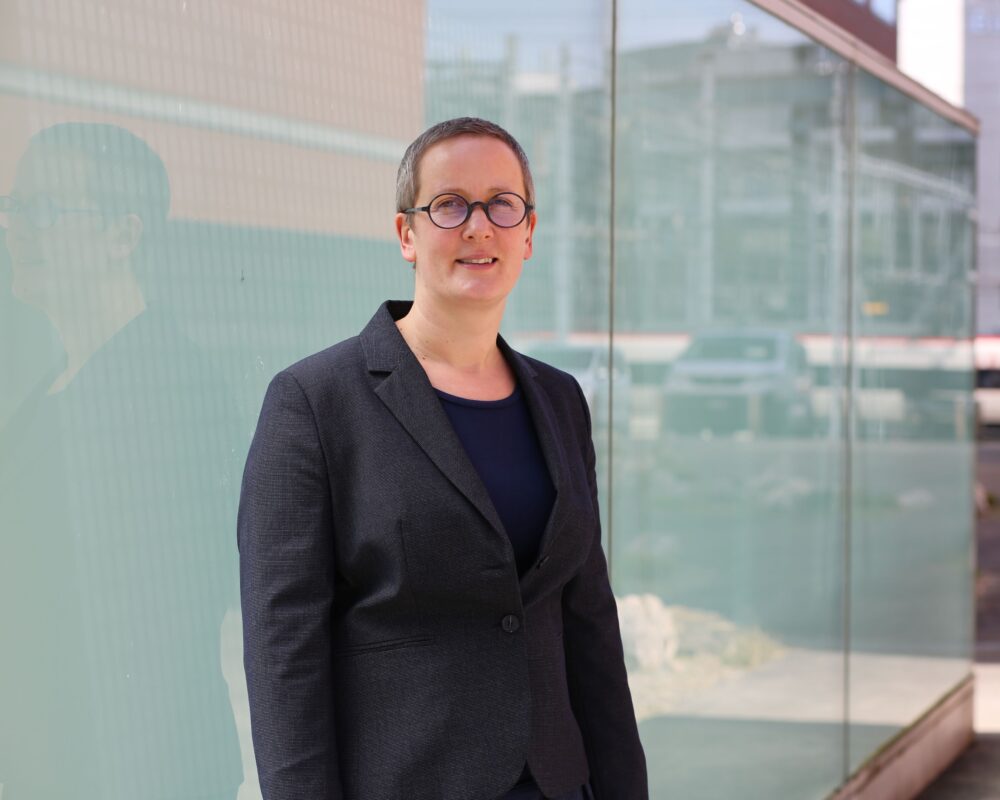
Artificial intelligence could reshape the landscape of literary translation. Chantal Wright, literary translator and professor at the Zurich University of Applied Sciences in Winterthur, speculates about the emergence of a two-tier system, where indie publishers prioritise human craftsmanship, and larger globalised publishers favour an AI-based solution.
A blog post by Chantal Wright
AI is coming for literary translation. Maybe. I would rather not begin this blog post by confessing to anxiety about the profession, but we are in a moment of particular flux and it’s hard to know exactly how the chips will fall. I’ve spent 25 years translating literature and thinking about literary translation. I have also just had the tremendous pleasure of co-translating a big book: the correspondence of Austrian poet Ingeborg Bachmann and Swiss playwright Max Frisch, alongside my colleague Simon Pare. But I know that as a profession we are at a caesura. In my other role as a professor at a Swiss university that has educated translators and interpreters since the 1950s, I am keenly aware that the (non-literary) language industry in which our students go on to work has changed profoundly over the past ten years, and that universities training language professionals are having to rapidly adapt their curricula to keep pace. I see the ongoing effects of technological change on student numbers, which have fallen, and hence on budgets, with the attendant repercussions for the job security of university lecturers.
One of the ironies of the current moment is that the revolution in commercial, non-literary, translation happened quite a long time ago. When the LLM-based chatbot Chat GPT arrived on the scene in late 2022, it may well have brought about a “mindset change” in customers, to quote Patrick Fassbender from the Swiss language service provider Diction AG, increasing their awareness of automation, but the fundamental change in translation workflows had taken place prior to ChatGPT, with the emergence of neural machine translation (DeepL & co.) in 2016-2017. Non-literary colleagues, both in-house language professionals and freelance translators, are now doing different types of work: editing, project-managing, consulting on a wide range of language-related services and technology. Is this where literary translation is heading too? Much of how things develop depends on a few issues: How appropriate is automated translation for literary texts? What will publishers, who hold the means of production, do? Where are literary translators in all of this?
Blanket statements about how well neural machine translation and more recent generative-AI systems deal with literary texts are problematic. Research into this is still developing, and would benefit from a more interdisciplinary approach that brings empirical methods from the social sciences together with more philosophical lines of enquiry from the humanities. Too often the quality criteria by which the success of a machine-produced translation is judged would not be the criteria used by practising translators, and indeed some of the most interesting work on non-human literary translation has come from a collective of practising translators based in Germany. We also have to exercise caution when making statements about what machine translation does not do well, since the technology is ever-evolving and what holds true may not hold true tomorrow or in twenty or a hundred years. The possibility of creating specialised literary translation systems that go beyond what a general-purpose LLM-based chatbot such as ChatGPT can offer is certainly there. Creative combinatorics can be practised by both humans and machines. AI systems have the advantage of speed and access to vast amounts of data; humans are embodied and live in the real world. Rather than focussing on what AI can or will be able to do with respect to literary translation, we should concern ourselves with what characterises human literary translation, and how it might develop in the future, a future that includes technology.
The means of production for literary translation lie with publishers. Whether or not translators will have work in the future depends on whether literary and academic publishers continue to place value on human translation, as the vast majority of them do at the moment, with some well-publicised exceptions (Harlequin France, Veen Bosch & Keuning, Taylor & Francis, Springer Nature). One vision of the future features a two-tiered system in which indie publishers – ironically, since the cost-saving afforded by machine translation would most benefit them – prioritise human craftsmanship, and the larger globalised publishers favour an AI-based solution. Alternatively, the market could divide along degrees of literariness, with highly literary texts and classics reserved for humans, and more generic literature left to the machine. This might in turn split the profession into, on the one hand, an elite group, potentially increasingly financed by national arts council grants in countries where these exist and, on the other hand, a group who practise literary post-editing, a much less satisfying activity than ‘translation proper’ for literary translators, who are, after all, writers. Authors will use their influence, or not, to have a say in how their books reach foreign audiences. Readers may also divide along the above lines: those who are bothered that the literature they read is created by humans and those who are not.
The headline of a recent feature piece (8 May 2026) on AI and translation in the British newspaper The Guardian was “Being human helps”. In this piece, translator Katy Derbyshire points out that being embodied is useful for the translation process: “My body has experienced all the pain and the joy that literature strives to convey”. Perfectly put. Translators live and breathe, have life experiences, are mortal; we read and interpret books, have personal libraries, both in our heads and on our shelves. Translators spend time, a great deal of time, with the texts that we translate. During the process of translation, we carry a text around in our bodies, minds and souls. Before a text comes to exist in a new language, it resides, for a while, within its translator, ripening. We are changed by the texts that we translate and the texts that we translate are changed by the very fact of being translated.
In my translation of a line from one of Ingeborg Bachmann’s letters to Max Frisch, I used the phrase “Love me do”. The letter is from 1962, which is the year The Beatles released their single. I had no idea if Ingeborg Bachmann ever listened to the Beatles, though it turns out that she did in fact, but I wanted to nod to her as a creature of her epoch. My mother, who died last year while I was translating the correspondence, was very much on my mind. On a visit to my hometown of Manchester, I walked past the old ABC Cinema, now the Apollo Theatre. The Beatles played two gigs there on 20 November 1963, captured in the short film The Beatles Come to Town. My mother was apparently among the hordes of teenage girls, the ones who couldn’t afford tickets, who stood outside the theatre, screaming in sexual ecstasy at the Fab Four. A new film about Ingeborg Bachmann, starring Sandra Hüller, will be released in Switzerland later this summer. The trailer for the film contains documentary footage of Bachmann, including an interview where she is asked if she believes, like the Beatles, that “all you need is love”. One corner of her mouth turns up in amusement, and she replies that naturally she hadn’t thought of the Beatles while she was writing. This is just one example of what human translation is. The translator is present in the text, in obvious and more subtle ways, making connections, often personal, serendipitous ones.
Translators have been much more willing to take up space in recent years, to be visible and present as public intellectuals, to talk about our creative craft and our intellectual work. We have also long been unofficial literary agents, even if a recent article (18 May 2026) in the German Süddeutsche Zeitung entitled “Why is everybody suddenly reading German novels?” completely ignores our contribution to making literature travel. But we are still uneasy when it comes to taking up space in our own translations. Putting “love me do” into the mouth of Ingeborg Bachmann may be a step too far for some. In the age of AI, however, we need to do more of this, not less. We have to translate as humans, or else we can soon cede the playing field.
There is no one way to be a human literary translator. For some it may mean radical rejection of the machine, on ethical, intellectual and/or environmental grounds, but it could also mean a willingness to experiment with the new technology at our disposal. Large language models give us access to the linguistic hivemind; for us wordsmiths, this is extremely useful. We should certainly continue to address and educate readers about what we do and what translations are and can be. If we can finally banish talk of fidelity – an empty word that always requires further qualification; faithful to what? and why?, remembering that Roland Barthes handed power over to the reader a long time ago – and encourage readers to delight in the fact that they are reading a different book, the product of two minds and two pens – the author’s and the translator’s – then literary translation will certainly have a future.
Chantal Wright is a literary translator (German and French > English). In 2024 she was appointed Professor for Creativity and the Language Industry in the Institute for Multilingual Communication at the Zurich University of Applied Sciences in Winterthur. She studied Modern and Medieval Languages at Cambridge University and completed a PhD in Literary Translation at the University of East Anglia. In 2017 she founded a new literary prize sponsored by Warwick University, the Warwick Prize for Women in Translation, which aims to increase the number of books written by female authors that are translated into English. In June 2026, she was elected to the Board of the Translation House Looren Association.
Her most recent translation project was a co-translation, with Simon
Pare, of the correspondence between Ingeborg Bachmann and Max Frisch,
forthcoming later this year with Seagull Books.